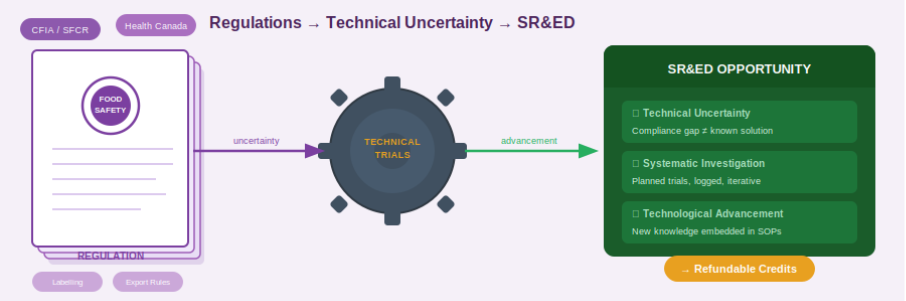
Regulatory change does not always create simple compliance work. In many cases, it forces businesses to alter products, processes, or operating conditions in ways that create real technical uncertainty. A new food safety rule, labelling requirement, export standard, or similar government obligation may define the outcome required, but not how to achieve it without affecting quality, yield, stability, or performance. When solving that problem requires structured technical investigation, the work may qualify as SR&ED.
Where the Technical Problem Begins
A common example is regulated manufacturing. A business may need to change its process to meet a food safety, labelling, export, or health requirement. In food processing, for instance, achieving a required internal temperature within a set time may sound straightforward, but the adjustment can create new technical issues such as moisture loss, texture changes, over-processing, or inconsistent results across the line.
That is often where the technical problem begins. Standard guidance may explain the rule, but it rarely tells a company how to meet it for its specific product, equipment, and production environment. To resolve that gap, businesses often need to test process settings, adjust supporting conditions, evaluate product or packaging variables, and measure the effect of each change against both the compliance target and the underlying commercial requirements.
What Counts as the Advancement
The SR&ED advancement is not the fact that the business complied with the regulation. Compliance is the trigger, not the claim. The advancement is the new technical knowledge developed to meet the requirement without causing unacceptable operational or product-related consequences.
That is why compliance-driven projects can be strong SR&ED claims:
- The requirement creates uncertainty,
- The team undertakes a systematic investigation,
- The work produces knowledge that did not previously exist in the business.
For many manufacturers, compliance-driven projects are some of the clearest examples of real technical problem-solving in the business. The key is recognizing when regulatory change forced genuine uncertainty and documenting the work properly.
Carnegie Capital Group helps businesses identify when compliance-driven development work may qualify for SR&ED and frame those claims around the underlying technical advancement.
Get in touch today
Email us today to check your eligibility — info@carnegiecapitalgroup.com